
Why sustainability today determines orders, costs and financing
Sustainability is no longer just an image topic for mid-sized companies. It now determines competitiveness, financing conditions, tenders and the stability of supply chains. The rules of the game in the market are changing: financing is becoming data-driven, tenders require CO₂ transparency, supply chains are being reassessed and customers increasingly prefer products that are efficient, durable and resource-saving.
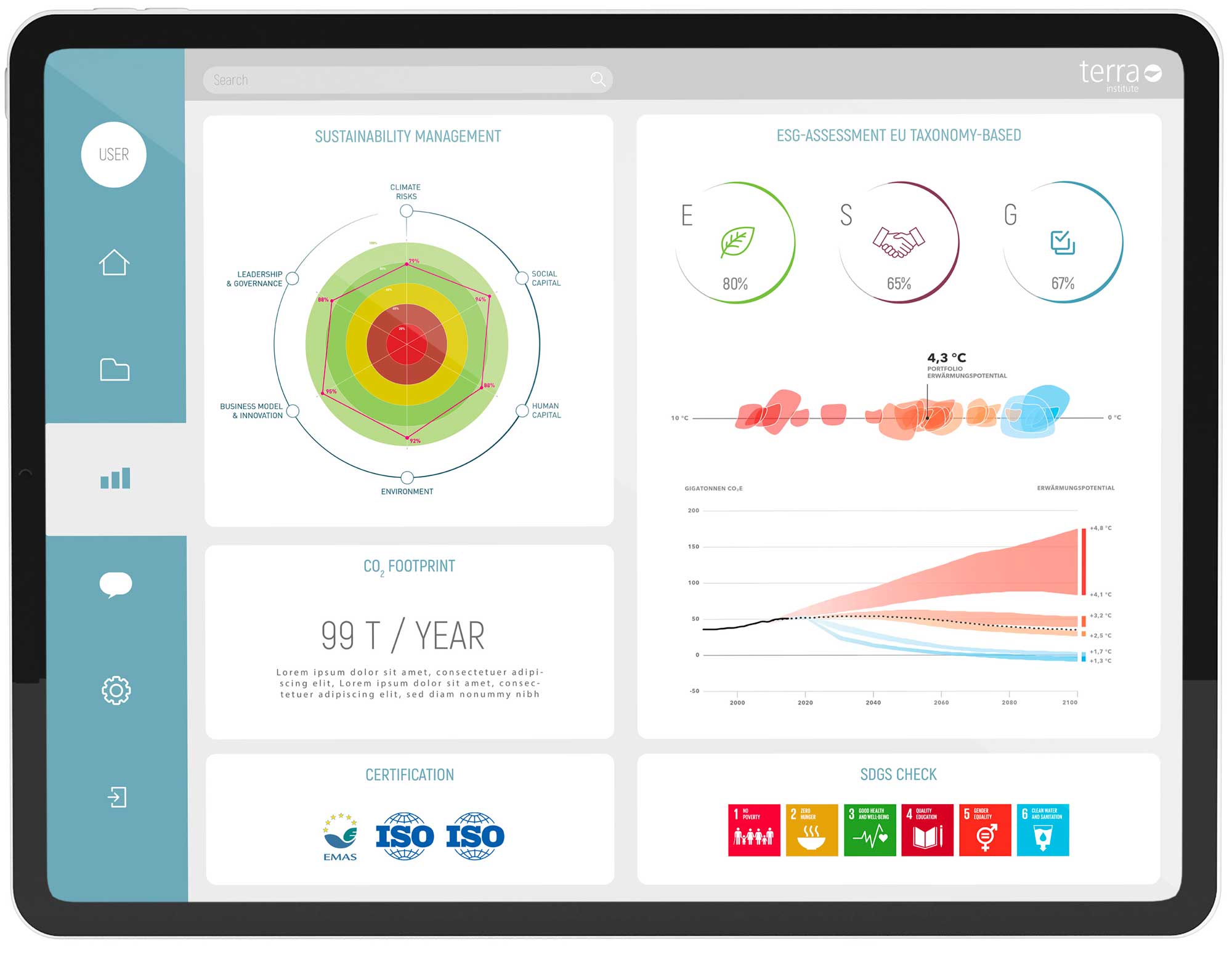
This puts ESG more firmly into the spotlight. ESG stands for Environmental, Social and Governance – in other words, environment, social responsibility and good corporate governance. In practice, this means: how efficiently a company uses energy and resources (E), how it treats people in its supply chain and workforce (S), and how well processes, data and decisions are managed (G). These are exactly the areas that increasingly determine how a company is perceived in the market – and whether it remains economically future-proof.
Of course, ESG brings additional effort – like any strategic transformation. But not taking action has now become the more expensive option. Those who act early lay the foundations for measurable economic advantages: lower costs, more stable supply chains, new markets and more attractive financing conditions. The effort pays off – often faster than expected.
So the key question is no longer: “Do we need ESG?” but: “How can we use ESG in a targeted way as a success factor for our business model?”
Change is happening – with or without us
Some companies are still waiting to see whether ESG will become “relevant enough”. But the transformation is already underway in every country, every region, every industry – regardless of whether you actively participate or not. And that is precisely where the risk lies: those who act too late can only react and have twice as much to catch up later – twice as much to invest – or will simply be left behind.
The fact is: companies that lag behind in the transformation are increasingly experiencing the following effects:
1. Financing becomes more expensive:
Banks are increasingly linking their lending to ESG data. Companies that cannot present reliable data on energy, emissions, supply chains or how they deal with climate risks appear riskier from a bank’s perspective. The result can be poorer financing conditions, higher interest rates or even rejected loan applications. For companies that want to invest, modernise or grow, this can quickly become a serious competitive disadvantage.
2. Key accounts are switching suppliers:
Due to supply chain laws, Scope 3 targets and internal climate strategies, large companies expect transparency from their suppliers. Those who cannot provide this transparency or cause above-average emissions lose business opportunities – often without it being communicated explicitly. SMEs that are heavily dependent on a few major customers are exposed to a very real revenue risk here.
3. Energy and material costs are rising in the long term:
Energy prices, raw material costs and CO₂ prices have not only risen in recent years, they are also remaining volatile. Companies that do not improve their processes and efficiency or fail to build alternatives will, in the long run, pay significantly higher operating costs than competitors who leverage energy efficiency, waste heat recovery or circular processes.
4. Market share is shifting:
Products that are repairable, durable, resource-efficient or climate-friendly are increasingly gaining ground. Companies that do not meet these expectations quickly appear expensive, outdated or risky. Those who react too late and continue to produce in a linear way risk losing price advantages and differentiation opportunities – and ultimately market share.
5. Employer attractiveness declines:
Young talent in particular increasingly expects clarity: what does the company stand for, how future-proof is it, how responsibly does it operate? Employers without a clear ESG strategy quickly appear unattractive – and lose talent to more modern competitors. This exacerbates existing bottlenecks, increases recruitment costs and impairs the company’s innovative strength.
6. Compliance and reputational risks increase:
Without solid ESG data, the risk of errors in reports, documentation or regulatory submissions rises. Compliance violations can lead to fines, sanctions or legal problems – and in the worst case to public criticism. Companies that cannot substantiate their sustainability claims also run the risk of being suspected of “greenwashing”.
I don’t want to scare you with this. The goal is not pressure, but strengthening your ability to act. The good news is: all of these risks can be addressed with the same measures that drive companies forward economically anyway – more efficient processes, better data, new business models and a clear strategy!
The six most effective ESG levers for mid-sized companies
In over 15 years of working with mid-sized companies, six levers have proven particularly decisive at Terra Institute:
- Embedding ESG in corporate strategy
- Reducing energy consumption & advancing decarbonisation
- Thinking about materials and products in circular terms
- Making supply chains stable and compliant
- Using data & reporting as a basis for management
- Enabling employees – building culture & competence
Below, you’ll find a brief overview of these levers and the opportunities they create. A detailed blog post with practical examples from our experts will follow shortly for each lever; we’ll link to them after the list of levers.
1. Embedding ESG in corporate strategy
Many companies already have PV systems, electric vehicles or their first ESG reports – but often there is no common thread: which measures truly support the business model? Which priorities make strategic sense?
An integrated ESG strategy enables you to:
-
Align investments clearly with value creation
-
Make risks and opportunities transparent
-
Strengthen your position in tenders and discussions with banks
-
Provide orientation for managers and employees
By the way: to get started, you generally don’t need your own dedicated department. Often, one clearly responsible person and a cross-functional steering committee are enough. Structures then grow with the task.
Link to the article (available from January 15th)
3. Circularity: reducing material costs, opening up new markets
For many companies, resource use is the largest cost factor. Circularity / circular economy reduces dependencies and opens up new revenue models.
Examples from mid-sized companies:
-
Retail: refurbish returns and offer them at a lower price instead of writing them off
-
Mechanical engineering: optimised maintenance, circular spare parts, service models (renting instead of selling)
-
Construction: circular components enable targeted deconstruction and reuse
The result: higher margins, lower price risks, more attractive products.
Link to the article (available from February 4th)
5. ESG data & reporting as a management basis
Many companies have measures in place – but no transparent data basis. With a few relevant KPIs, costs can be reduced, decisions improved and reporting significantly simplified.
Important are:
-
Data on energy, CO₂, waste, water consumption and key supplier indicators
-
Clearly defined data processes
-
Simple digital tools (from meters to ESG software)
The result: with reliable data, efficiency and speed increase – and your financial attractiveness to banks and customers improves.
Link to the article (available from February 18th)
2. Decarbonisation & energy efficiency – rapid economic impact
Energy is one of the largest cost blocks in mid-sized companies. Every optimised system, every reduction in peak loads, every PV installation directly affects the profit and loss statement – and improves both the CO₂ balance and financing conditions.
Effective starting points:
-
Process optimisation & control technology
-
Replacing old machinery with efficient technology
-
Switching to renewable energy (PV, heat pumps, waste heat utilisation)
-
Analysing fleet and business travel for economically viable e-mobility
The result: lower operating costs, greater planning reliability, better ratings.
Link to the article (available from January 29th)
4. Making supply chains stable and compliant
With CSDDD, CSRD and internal climate targets, the need for ESG information in large companies is increasing. For mid-sized businesses, this means: those who can provide transparency remain able to deliver and win new contracts.
A pragmatic starting point:
-
Identify key suppliers
-
Prepare a simple ESG questionnaire
-
Conduct risk and location assessments
-
Communicate minimum standards
-
Develop improvements together
The result: stable supply chains become a true competitive advantage.
Link to the article (available from February 11th)
6. Enabling employees: building culture & competence
Kultur: Orientierung, Führung & Zusammenarbeit als Fundament
Culture: orientation, leadership & collaboration as the foundation
Effective ESG alignment needs more than technology and processes – it needs a culture that guides decisions and brings employees along. Purpose, vision and mission show what the company stands for and how sustainability strengthens its future viability. Managers play a key role: they set priorities, make clear decisions and ensure that ESG is embedded in day-to-day work.
Key cultural building blocks:
-
Clear alignment: connect purpose, vision and mission with ESG
-
Define the role of leadership: provide orientation, explain decisions, act as role models
-
Strengthen diversity, equity & inclusion: different perspectives foster innovation and employer attractiveness
-
Communication: convey goals, progress and expectations in an understandable and transparent way
The result: a strong culture creates the foundation for measures to take effect more quickly – and for sustainability to be understood and supported as an economic topic.
Enabling employees – knowledge, skills & implementation power
Measures only become effective when employees understand what impact they can have. Education and training are therefore among the strongest levers of transformation – and are often the point in mid-sized companies where ESG really “starts to move”.
Effective starting points:
-
Practice-oriented training (online/offline) on topics such as energy, CO₂, circularity, supply chain or reporting, and on the role of managers, specialist departments and operational teams
-
Workshops & idea programmes for quick wins and employee engagement
-
Pilot projects to test new solutions on a small scale and gain experience
The result: faster improvements, better everyday decisions and greater employer attractiveness.
By the way: Terra Academy supports companies with role-specific e-learnings and live trainings that are specially designed for mid-sized structures – pragmatic, easy to understand and directly applicable.
Link to the article (available from February 24th)
Playbook: how mid-sized companies use ESG to open up new markets
To ensure these levers have the greatest possible impact, the following principles have proven themselves in successful transformation projects:
-
Build partnerships along the value chain: innovation rarely happens in isolation!
-
Rethink capex (capital expenditure): prioritise investments that measurably strengthen efficiency, CO₂ reduction or circular processes!
-
Use opex models (operating expenditure): service and rental models reduce capital commitment and lower risk!
-
Professionalise data architecture: financial, operational and sustainability data belong in one integrated management system!
-
Prioritise pilot fields: start where impact and scaling potential are greatest!
Conclusion: ESG is a business lever – not additional overhead
Companies that use sustainability strategically benefit above all in four areas:
- Cost reduction (energy, materials, inefficient processes)
- Growth (new customer groups, tenders, new business models)
- Resilience (more stable supply chains, planning reliability)
- Employer attractiveness
Those who integrate ESG into their strategy early on, use energy and materials more efficiently, understand their supply chains and work with data are building today the competitive edge of tomorrow.
Terra Institute supports companies precisely at this interface – from strategy, decarbonisation, circularity, supply chains and reporting through to leadership and culture.
Terra Academy provides the necessary know-how so that people understand transformation and can actively shape it.
In the next articles in this series, we will delve deeper into each lever – with practical examples, cost-benefit calculations and concrete entry options.
Author

Kim Y. Mühl
Kim is passionate about sharing knowledge. As an author, lecturer, keynote speaker and trainer, he has been working for many years on topics such as bionics, digitalisation, finance, sustainability, purpose and strategy. In addition, the former Head of Research & Business Development Europe at a global financial technology service provider brings extensive experience in process and project work as well as team leadership.
Today, as Senior Learning Consultant with Terra Academy, he supports companies and their people on the path towards a sustainable economy and working world.
Questions? Feel free to get in touch by email (k.muehl@terra-institute.eu)